

Publikationen
Neuerscheinungen
Lucas Prieske / Erika Meibauer / Pauline Schubert / Christoph Wunsch: Stille Gefahr. Zur literarischen Inszenierung verborgener Bedrohungen. Hannover 2026.
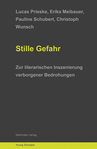 Wenn eine Gefahr nicht sinnlich erfassbar ist, entsteht eine riskante Lücke zwischen gesellschaftlichem Wissen und Handeln. Dieser Sammelband, entstanden im Kontext des Sonderforschungsbereichs 1369 »Vigilanzkulturen« sowie des Geisteswissenschaftlichen Kollegs der Studienstiftung des deutschen Volkes, analysiert das Phänomen der ›stillen Gefahr‹ als Phänomen historischer Bedrohungsgrammatiken. Die Beiträge gehen der Frage nach, wie literarische Texte dort einspringen, wo Instrumente des gesellschaftlichen Gefahrensinns an ihre Grenzen stoßen.
Anhand prägnanter Fallstudien wird aufgezeigt, wie Literatur auf entsprechende Krisen ihrer jeweiligen Zeit reagiert. So inszeniert Friedrich Schiller in der Spätaufklärung die Intrige als ›Schwarzkunst‹, die sich die mangelnde Wachsamkeit des Opfers gegenüber seinem eigenen Inneren zunutze macht. Heinrich Heine bearbeitet wiederum die Pariser Cholera-Epidemie von 1832 im Gestus eines Kriegsberichterstatters, um das Verhältnis von Krankheit, politischem Misstrauen und historischem Bewusstsein neu zu vermessen. Die technisierten Bedrohungen des 20. Jahrhunderts fordern die literarische Darstellung schließlich auf neue Weise heraus: Während Walter Benjamin und Dora Sophie Kellner die in mehrfacher Hinsicht schlechte Wahrnehmbarkeit eines drohenden Gaskriegs analysieren, reflektiert Christa Wolf angesichts der unsichtbaren Strahlung nach der Reaktorkatastrophe von Tschernobyl die Grenzen der Sprache selbst.
Der vorliegende Band eröffnet in einem historischen Längsschnitt schlaglichtartige Reflexionsräume, um die stille Wirksamkeit verborgener Bedrohungen zu verstehen.
Agnes Casadevall Ferrer: Die Wächterstimme im Hohenfurter Liederbuch. Berlin/Boston 2026.
DOI: https://doi.org/10.1515/9783112215708
 Mit unikal überlieferten Liedern mit jeweils notierten Melodien ist das Hohenfurter Liederbuch ein Sonderfall der spätmittelhochdeutschen Liederbuchlyrik, der bisher randständig untersucht wurde. Die vorliegende Studie fragt nach der Zusammenstellung der Lieder und versucht eine Neuinterpretation der Wächterfigur im geistlichen Lied. Im ersten Teil werden Aufbau, Aufmachung und Hintergründe der anonym überlieferten Handschrift beschrieben. Der Heterogenität im Liedteil des Hohenfurter Liederbuchs, welcher neben geistlichen Tageliedern auch Weihnachts-, Oster- und ein Krautgartenlied enthält, wird der Blick auf die Rubriken über den ‚grossen sünder‘ als roter Faden gegenübergestellt. Im zweiten Schritt interpretiert die Studie fünf Lieder mit dem Fokus auf das Bekehrungsgeschehen um den ‚grossen sünder‘. Zentral ist dabei eine Wächter- und Wecksemantik, die u.a. aus Kontexten des weltlichen Tagelieds und der christlichen Hymnentradition zehrt. Die Liedinterpretationen decken dabei schrittweise die unterschiedlichen Dimensionen dieser Semantik auf. Insgesamt liefert die Studie entscheidende Erkenntnisse zur Kultivierung von Wachsamkeit, wie sie das hier im Zentrum stehende Liederbuch für das Spätmittelalter bezeugt.